
18 May How to Plan Accessibility for a North Texas Office Renovation
Office renovations in North Texas range from cosmetic refreshes to full gut-and-rebuild projects. Regardless of the scope, any renovation that affects the physical layout of a commercial building can trigger accessibility requirements under the Americans with Disabilities Act and the Texas Accessibility Standards. For contractors and facility managers, understanding when these requirements apply and how to plan for them early is essential to keeping projects on schedule and avoiding costly corrections after the fact.
This guide covers the key accessibility requirements that apply to office renovations in Texas, the common areas where contractors miss compliance, and how to approach vertical access planning in multi-story office spaces.
When Does an Office Renovation Trigger ADA Requirements?
The ADA requires that when a commercial building undergoes alterations, the altered areas must be made accessible to the extent that it is technically feasible. This is not limited to major construction projects. Even relatively modest renovations, such as reconfiguring a reception area, moving interior partitions, or upgrading restrooms, can trigger accessibility obligations in the altered portion of the building.
In Texas, the Texas Accessibility Standards administered by the Texas Department of Licensing and Regulation apply to all commercial construction projects, including renovations. TDLR requires that projects meeting certain cost thresholds bring the affected areas into compliance with TAS. Contractors should verify the applicable threshold and scope with a registered accessibility consultant or TDLR before finalizing renovation plans.
Common Accessibility Issues in Office Renovations
Several accessibility issues come up repeatedly in North Texas office renovation projects. Addressing these early in the design phase is far less expensive than correcting them after construction is complete.
Path of Travel Requirements
When a primary function area, such as a conference room, break room, or main work area, is altered, the ADA requires that the path of travel to that area also be made accessible. This can include corridors, doorways, restrooms, and building entrances. Contractors who focus only on the altered area and overlook the path of travel can find themselves facing significant additional work. For multi-story buildings, this often means evaluating whether a vertical platform lift or elevator is required to provide an accessible route to the renovated floor.
Door Width and Hardware
ADA-compliant accessible routes require a minimum clear width of 32 inches at doorways, with 36-inch-wide doors recommended. Lever-style hardware is required in place of round knobs. Office renovations that involve new or relocated doorways should confirm these dimensions are met in the construction drawings before work begins.
Reception and Service Counters
Office reception counters must include an accessible section no higher than 36 inches and at least 36 inches wide. If the renovation includes a new or reconfigured reception area, this requirement applies. The accessible counter section must be on an accessible route and usable from a wheelchair approach.
Restroom Accessibility
If restrooms are included in or adjacent to the renovation scope, they must meet ADA and TAS requirements for accessible stall dimensions, grab bar placement, fixture height, and clear floor space. Restroom upgrades are frequently overlooked as a path of travel requirement even when the restrooms themselves are not the primary renovation focus.
Vertical Access Planning in Multi-Story Office Buildings
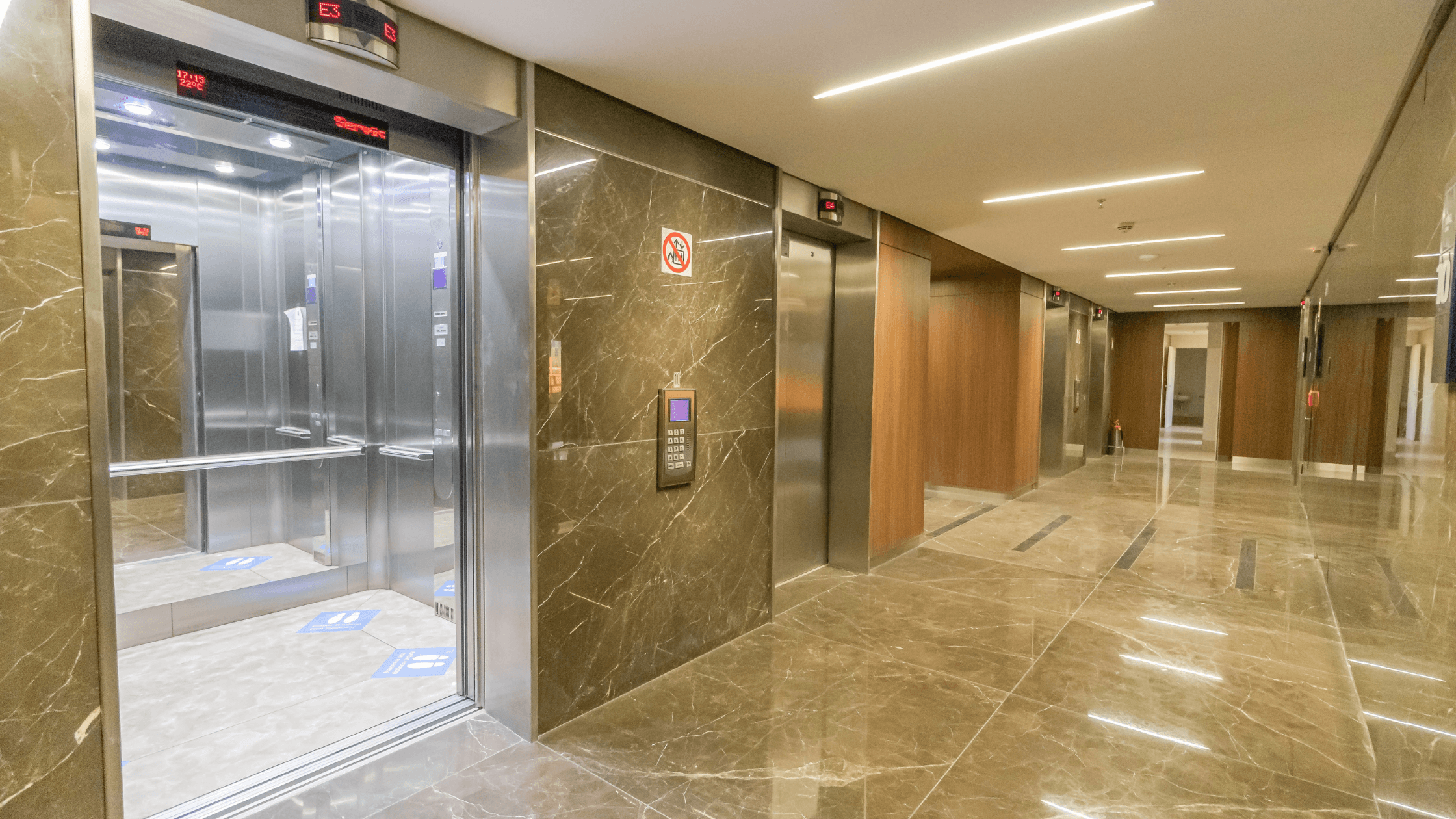
One of the most significant accessibility decisions in a multi-story office renovation is how to provide compliant vertical access between floors. The two most common solutions for North Texas office buildings are vertical platform lifts and traditional commercial elevators.
Vertical platform lifts are frequently used in smaller office buildings, professional suites, and historic properties where a full commercial elevator is not practical. They meet ADA and TAS requirements for vertical access in many applications and can often be installed with significantly less structural impact than a full elevator. See our guide on vertical platform lifts vs. ramps for a detailed comparison of how VPLs stack up against other accessibility solutions in commercial settings.
For larger office buildings or projects where a VPL does not meet the applicable code requirements, a commercial elevator may be required. Lift-Aids works with contractors and building owners to evaluate the applicable requirements and identify the right vertical access solution for the specific project.
Working With a TDLR-Registered Accessibility Consultant
Texas requires that certain commercial renovation projects be reviewed by a registered accessibility consultant before a building permit is issued. The consultant reviews the plans for TAS compliance and provides a certification that is submitted with the permit application. Contractors should factor this review into the project schedule, as it adds time to the front end of the permitting process.
Lift-Aids works alongside accessibility consultants and general contractors on North Texas office renovation projects to ensure that vertical access solutions are specified correctly and installed in compliance with applicable codes. If your project is in the planning phase and you have questions about vertical access requirements, contact Lift-Aids for a project review.
Planning Ahead: The Cost of Getting It Wrong
Accessibility corrections on commercial renovation projects are among the most expensive change orders a contractor can face. A vertical access solution that is specified too late, or a path of travel that was not addressed in the original scope, can require structural rework, additional permitting, and project delays that affect the building owner’s operations.
The most effective way to avoid these costs is to address accessibility requirements at the schematic design stage, before construction documents are finalized. Lift-Aids can provide early-stage input on vertical access requirements, product options, and rough cost ranges to help contractors and facility managers make informed decisions before the project is underway. Request a free estimate to get started.