
10 Nov Stairlift, Inclined Platform Lift, or Vertical Platform Lift for Rehab Homes: A Compliance Guide for Architects and Builders
For architects, accessibility planners, and commercial builders designing or remodeling rehabilitation centers, assisted living facilities, or group homes classified as Institutional Group I-1 occupancy, the choice of a lift system affects more than function. It affects compliance. In these environments, the chosen lift must provide a safe, continuous Accessible Route for residents who rely on wheelchairs, scooters, or other mobility devices.
Selecting the wrong type of lift can lead to code violations, project delays, and costly reconstruction. This guide provides a clear comparison of the three most common lift options used in institutional and rehab home settings and explains how each one fits into Texas Accessibility Standards (TAS) and ADA requirements.
Understanding the Accessible Route Requirement
The most important regulatory detail for any institutional facility is the Accessible Route requirement. TAS specifies that all accessible spaces and elements must be connected by a continuous Accessible Route. This route comprises components that are permitted under accessibility law. Those components include walking surfaces, doorways, ramps, curb ramps, elevators, and platform lifts.
The term platform lifts refers only to Vertical Platform Lifts (VPLs) and Inclined Platform Lifts (IPLs). Stairlifts are not included in this category and are not recognized as compliant components of an Accessible Route. This distinction is often the determining factor when planning vertical mobility inside rehabilitation facilities or group homes.
Option 1: Stairlifts
A stairlift is a seated device that travels along a rail mounted to a staircase. Stairlifts are commonly used in private homes and can support aging-in-place goals. However, they are not designed to serve as part of a compliant Accessible Route in commercial or institutional facilities.
Why Stairlifts Are Not Suitable for Rehab Homes
They require a user transfer
A stairlift requires the user to leave their wheelchair or mobility device and transfer to a seat. In a rehabilitation or assisted living setting, this often requires staff assistance and increases the risk of falls or other incidents. It does not support independent access.
They are not recognized as Accessible Route components
TAS does not list stairlifts as an approved element of a compliant Accessible Route. Because of this, they cannot be used to meet accessibility requirements in Institutional Group I-1 facilities.
They can reduce the required egress width
Staircases in commercial or institutional buildings must maintain a minimum clear walking width for emergency egress. The rail and folded chair of a stairlift can reduce the usable width of the stairs, which may create life safety concerns.
When a Stairlift May Be Appropriate
A stairlift can be considered only as a secondary mobility option for staff or ambulatory residents. It cannot serve as the required Accessible Route between accessible spaces.
Option 2: Vertical Platform Lifts (VPLs)
A Vertical Platform Lift moves vertically on an open or partially enclosed platform. TAS and the ADA recognize VPLs as compliant components of an Accessible Route when installed correctly.
VPLs allow users to remain in their wheelchairs or scooters, supporting higher independence and reducing the need for transfers. This alone makes them a strong choice for rehabilitation-centered environments.
Travel Height Determines Which VPL Is Allowed
There are two primary types of VPL systems used in commercial settings.
Unenclosed VPL (VPL-UL)
• Maximum travel height is typically up to 60 inches.
• Construction needs are minimal and often limited to a level pad or small landing.
• Ideal for bypassing short sets of steps or raised platforms.
Shaftway VPL (VPL-SL)
• Can travel up to approximately 14 feet.
• Requires a dedicated, contractor-built hoistway enclosure.
• Appropriate for full floor-to-floor access in low-rise buildings.
Why Travel Height Matters
Any vertical rise exceeding 60 inches requires a fully enclosed shaft. This significantly changes construction planning, requiring framing, fire considerations, and additional engineering. Many accessibility planning issues occur when a project begins with an unenclosed lift assumption and later learns that the height exceeds allowable limits.
When to Choose a VPL
• The elevation change is less than 60 inches, and minimal construction work is preferred.
• A new institutional building requires accessible vertical travel between floors.
• A shaftway can be designed into the building from the beginning.
Option 3: Inclined Platform Lifts (IPLs)
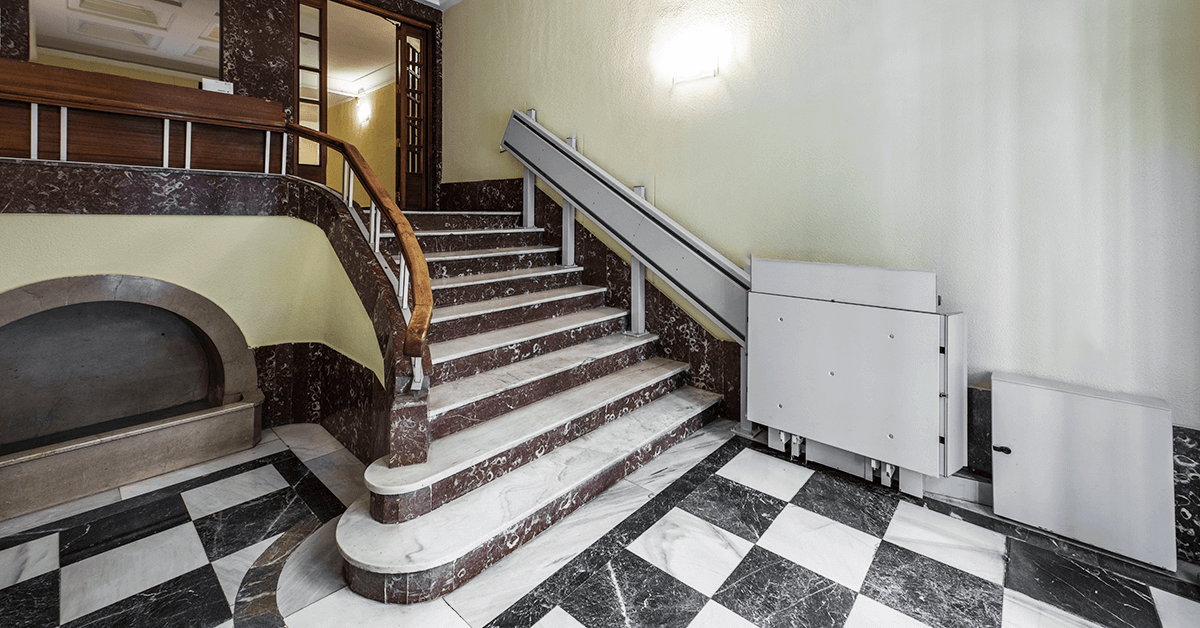
An Inclined Platform Lift travels along the angle of a staircase on a rail system. IPLs are particularly valuable in retrofit conditions where adding a vertical shaft would be expensive or physically impossible.
In older buildings or facilities with extremely limited space, an IPL may be the only practical way to create a compliant Accessible Route.
The Egress Width Constraint
IPLs fold when not in use, but they still take up space on the stairway. This means the staircase must remain wide enough to maintain the required egress path even with the lift folded.
If the staircase does not meet minimum clearance requirements once the lift is installed, the IPL cannot be used in the facility.
When to Choose an IPL
• The project involves retrofitting an existing building with limited structural modification options.
• The staircase is wide enough to maintain the required egress clearance when the lift is folded.
• A VPL is not feasible due to height, budget, or structural limitations.
Summary for Construction Planners
Choosing the correct accessibility solution for rehab homes and other institutional settings requires careful evaluation of two primary factors: vertical travel height and available egress clearance.
Guide for Selecting the Correct Lift
Short Rise Access (Under 5 Feet)
Choose: Vertical Platform Lift (Unenclosed)
Reason: Provides compliant access with minimal construction demands.
Multi-Level Retrofit With Sufficient Stair Width
Choose: Inclined Platform Lift
Reason: Designed for retrofit applications and compliant when egress clearance is maintained.
Multi-Level New Build or Narrow Stairways
Choose: Shaftway Vertical Platform Lift or LU/LA Elevator
Reason: Required for travel greater than 5 feet or when an IPL cannot maintain a safe egress width.
Accessible Route Requirement
Avoid: Stairlifts
Reason: Stairlifts are not recognized as compliant components of the Accessible Route.
Supporting Architects and Builders Across North Texas
Lift-Aids, Inc. supports North Texas architects, planners, and builders by helping them evaluate lift options, understand accessibility requirements, and prepare accurate specifications for commercial and institutional projects. Our team assists with planning considerations to reduce rework and support long-term safety.
We proudly support accessibility planning across North Texas, including Dallas, Fort Worth, Waco, Tyler, Lufkin, Longview, Marshall, Texarkana, Sherman, McKinney, Plano, Denton, Wichita Falls, Abilene, Lubbock, Childress, Amarillo, Canadian, Big Spring, Midland, Odessa, San Angelo, Kermit, and El Paso.