
26 Jan Why Short-Rise Accessibility Barriers Are Often Missed in Commercial Buildings
In North Texas commercial real estate, accessibility planning often focuses on large installations such as elevators or exterior ramps. Yet many compliance challenges stem from something much smaller: short-rise barriers.
Elevation changes between 2 and 60 inches are easy to overlook during early walkthroughs. However, these level changes can create significant compliance issues under ADA and Texas Accessibility Standards (TAS). When identified late in a project, they often require fast, costly corrections.
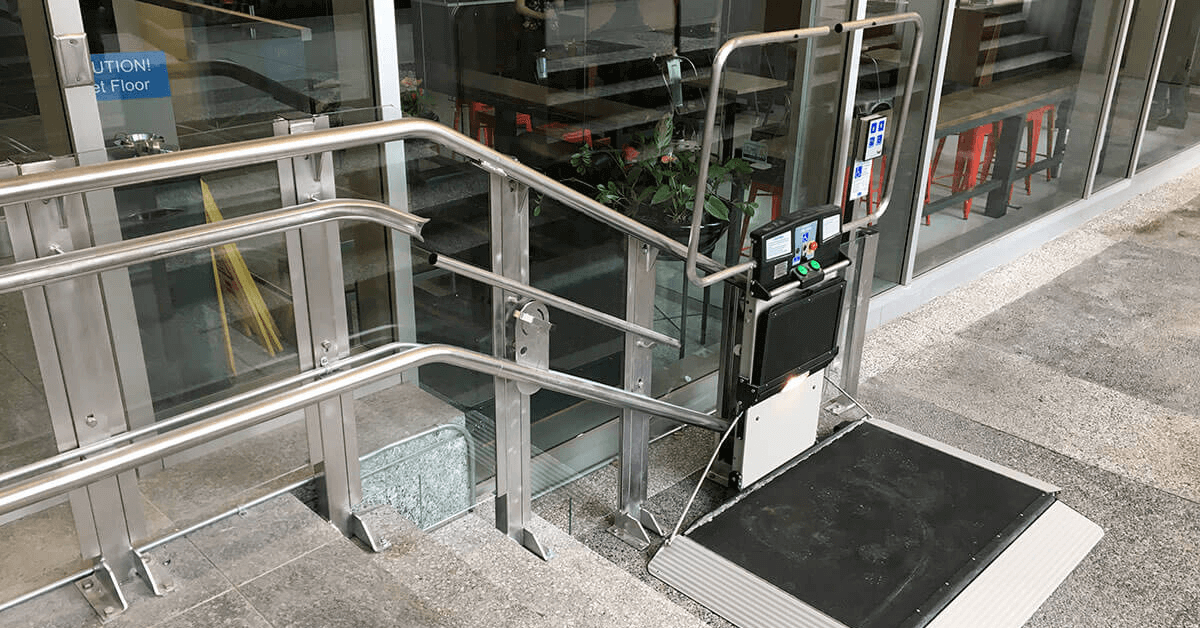
This guide explains why short-rise barriers are frequently missed and how engineered vertical solutions can provide a practical, space-efficient alternative to traditional ramps.
The Overlooked Barrier: Why Small Level Changes Create Big Problems
Short-rise barriers appear in many commercial environments, including:
- Split-level office suites
- Raised mezzanines in warehouses
- Single-step storefront entries
- Slight elevation transitions between tenant spaces
Because these transitions do not span an entire story, they are often viewed as minor. That assumption can lead to compliance delays, design revisions, and inspection setbacks.
Understanding the 1/4-Inch Rule
Under ADA and TAS guidelines:
- Vertical changes greater than 1/4 inch must be beveled
- Changes greater than 1/2 inch require a compliant ramp or lift
Even a single step at an entrance can require a permanent accessibility solution. What appears minor during design can become a failed inspection at the final stage.
Aesthetic Considerations That Delay Compliance
In boutique retail spaces or professional offices, teams may hesitate to introduce a ramp due to visual concerns. Accessibility features are sometimes postponed until late in the buildout process.
When accessibility is deferred instead of integrated early, solutions often become more expensive and disruptive.
The Ramp Footprint Challenge
Ramps require significant horizontal space. For example, clearing a 30-inch rise at a 1:12 slope typically requires approximately 30 feet of ramp run, not including landings.
In modern commercial layouts where square footage directly affects lease value, dedicating that much space to a ramp is not always feasible.
Vertical Platform Lifts vs. Ramps: A Technical Comparison
When a short-rise barrier is identified, the choice often comes down to space, usability, and installation logistics.
Space Efficiency
A Vertical Platform Lift (VPL) typically occupies a compact footprint of approximately 5 feet by 5 feet, depending on the model and configuration. This footprint remains consistent regardless of rise, within manufacturer limits.
For facilities where floor space directly impacts operations or revenue, preserving usable square footage can be a major advantage.
User Accessibility and Independence
While ramps provide continuous access, they may be physically demanding for individuals with limited upper-body strength or mobility challenges.
A properly specified VPL can support independent, push-button operation, depending on the model and installation conditions. This can improve daily usability for building occupants and visitors.
Installation Timeline Considerations
Concrete ramps require site preparation, forming, pouring, and curing time. In contrast, many surface-mounted VPL systems can be installed and commissioned within a single business day, depending on site readiness and electrical coordination.
For projects approaching a TAS inspection deadline, this efficiency can help minimize delays. Installation timelines vary based on site conditions and code requirements.
Navigating Texas Accessibility Standards and ADA Compliance
In Texas, compliance requires careful coordination with the Texas Department of Licensing and Regulation (TDLR).
TAS vs. ADA Requirements
Although ADA and TAS are largely aligned, TAS may include additional technical requirements such as specific clear floor space dimensions and maneuvering clearances.
For example, TAS often requires a minimum clear floor space of 36 inches by 48 inches in certain applications. These details can affect layout decisions and equipment selection.
National franchises operating in Texas sometimes overlook these distinctions, which can lead to unexpected revisions.
The Importance of a Licensed Texas Elevator Contractor
Partnering with a Licensed Texas Elevator Contractor helps ensure that:
- Equipment selection meets TAS and ADA requirements
- CAD submittals align with architectural drawings
- Electrical specifications are correctly coordinated
- Documentation is prepared for state inspection
Proper planning and documentation can help reduce the risk of inspection delays or required modifications.
Reducing Legal and Operational Risk
Unaddressed short-rise barriers are common sources of accessibility complaints and litigation. Installing a permanent, code-compliant lift or ramp provides a documented accessible path of travel.
While no solution eliminates all risk, properly engineered and permitted equipment can help demonstrate a good-faith effort toward compliance.
Strategic Considerations for Facility and Operations Leaders
Short-rise barriers should not be treated as afterthoughts. Early identification during design or renovation planning helps avoid costly last-minute changes.
Temporary solutions such as portable ramps may not meet safety or unassisted use standards in many commercial applications. Permanent, properly installed lifts or ramps typically provide greater long-term reliability.
By addressing elevation changes early and selecting appropriate engineered solutions, facility managers can:
- Support safer access for employees and visitors
- Reduce inspection risk
- Preserve usable square footage
- Maintain project timelines
At Lift-Aids, we work with commercial property owners, architects, and contractors throughout North Texas to evaluate short-rise accessibility challenges and recommend solutions that align with code requirements and operational goals.
If you are planning a buildout, retrofit, or renovation, consult with a qualified accessibility specialist early in the process to review potential level changes before they impact your inspection schedule.
Disclaimer: This content is for general informational purposes only and does not constitute safety, engineering, or regulatory advice. Equipment selection and performance vary based on application, environment, installation conditions, and usage.