
23 Feb Home Elevator vs. Stair Lift: Choosing the Right Aging-in-Place Solution for Your Home
For many North Texas homeowners, aging in place means maintaining independence while continuing to live in the home and community they value. Over time, however, stairs can become one of the biggest obstacles to remaining comfortable in a multi-story home.
When planning for long-term accessibility, families often compare two common solutions: stair lifts and residential elevators. Both options can improve access between floors and support safer mobility, but they differ in installation requirements, long-term flexibility, and impact on the home.
Understanding these differences can help homeowners, families, and accessibility planners choose the solution that best fits current and future needs.
Stair Lifts: A Practical Solution for Immediate Accessibility
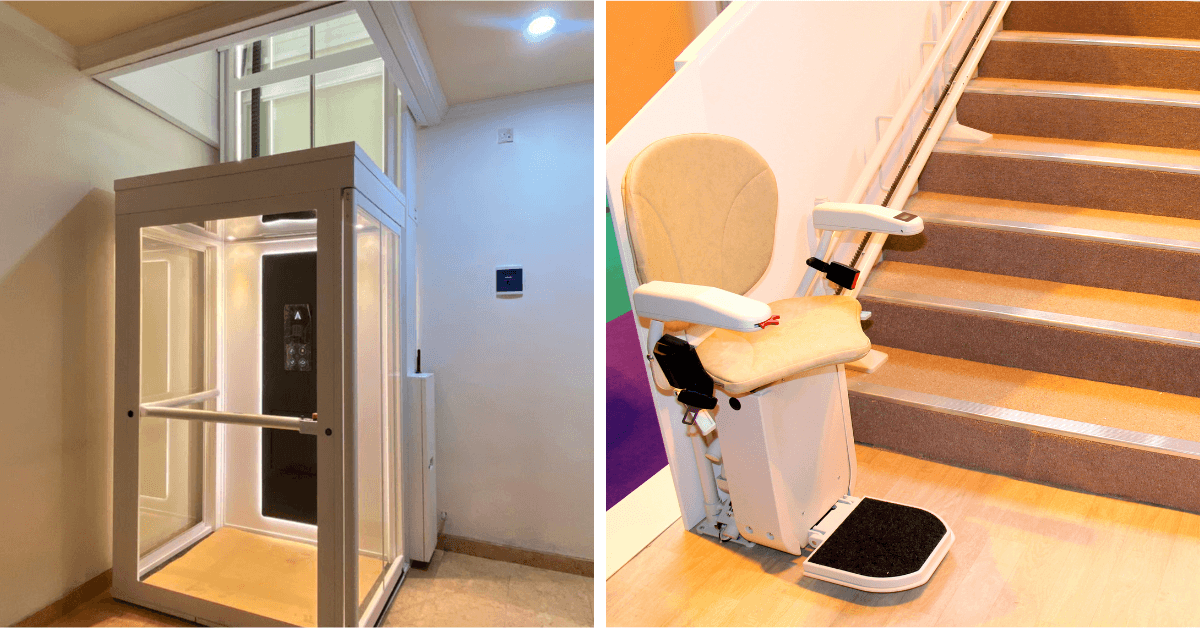
A stair lift is often the first option homeowners consider when stairs become difficult to navigate. The system includes a motorized chair that travels along a rail mounted directly to the stair treads rather than the wall.
Because stair lifts typically require minimal structural work, they can often be installed quickly and with limited disruption to the home.
Key Advantages of Stair Lifts
Fast Installation
For situations where accessibility needs arise quickly, such as after a hospital discharge or injury, a straight-rail stair lift can often be installed in a matter of hours.
Lower Initial Cost
Stair lifts generally represent the most budget-friendly option for overcoming a single flight of stairs in an existing home.
Minimal Structural Changes
Since the rail attaches directly to the stair treads, installation usually does not require major modifications to the structure of the home.
Considerations for Long-Term Mobility
While stair lifts can work well for individuals who are able to sit and stand safely, they do require the user to transfer from a wheelchair or walker at both the top and bottom of the stairs.
For individuals whose mobility needs may change over time, this transfer requirement may become more challenging.
Homeowners who anticipate progressive mobility limitations may want to evaluate long-term accessibility solutions during the planning process.
Learn more about stair lift solutions here: https://www.lift-aids.com/wheelchair-mobility-lifts/
Residential Elevators: A Long-Term Accessibility Investment
A residential elevator is a permanent vertical transportation system designed to move people, mobility devices, and household items between floors. Systems such as the Elvoron residential elevator are designed to integrate into both new construction and retrofit applications.
Unlike stair lifts, residential elevators allow users to travel between floors without transferring from a wheelchair, walker, or other mobility device.
Benefits of Installing a Home Elevator
Accessible Route Between Floors
Residential elevators create a continuous accessible path throughout the home. This can support long-term mobility needs and accommodate wheelchairs or walkers.
Convenience Beyond Mobility
Elevators are also frequently used to move groceries, laundry, luggage, or other heavy items between floors, which can make daily living more convenient for many households.
Potential Property Appeal
In many North Texas communities, including Keller, Southlake, and surrounding areas, residential elevators are often viewed as a premium home feature. While resale value can vary by market and property, accessibility upgrades may contribute positively to long-term home appeal.
Smooth and Quiet Operation
Modern residential elevator systems use advanced drive technologies, such as hydraulic or traction systems, designed to provide a stable and quiet ride.
Explore residential elevator options:
https://www.lift-aids.com/residential-elevators/
Technical Comparison: Stair Lift vs. Residential Elevator
| Feature | Stair Lift | Residential Elevator |
| Installation Time | Often completed within a day | Typically 2–4 weeks plus construction |
| Structural Changes | Minimal | Requires a hoistway or shaft |
| Mobility Device Access | User transfers from a wheelchair or walker | Mobility devices travel with the user |
| Capacity | Approximately 300–500 lbs | Approximately 750–1,400 lbs, depending on model |
| Impact on Home Value | Typically neutral | May enhance long-term home appeal |
Planning Ahead: Considering Future Mobility Needs
When helping homeowners evaluate accessibility options, one common planning approach is to consider future mobility needs over the next several years.
If a homeowner expects that wheelchair use may become necessary in the near future, installing a residential elevator may provide greater long-term accessibility and convenience.
If the primary concern is reducing strain from stairs due to knee pain, fatigue, or mild mobility limitations, a stair lift may provide a practical and efficient solution.
Every home and mobility situation is different, which is why professional evaluation is an important step when selecting accessibility equipment.
Why Professional Installation Matters
Regardless of which system is selected, the safety and reliability of accessibility equipment depend heavily on proper installation and ongoing service.
In Texas, residential elevators must be installed by a Licensed Texas Elevator Contractor. Working with an experienced provider helps ensure that equipment is installed in accordance with ASME A17.1 safety standards and local regulatory requirements.
Lift-Aids has served North Texas homeowners since 1968, providing accessibility solutions backed by experienced technicians and local service support.
Learn more about Lift-Aids accessibility solutions: https://www.lift-aids.com/
Disclaimer:
This content is for general informational purposes only and does not constitute safety, engineering, or regulatory advice. Equipment selection and outcomes vary based on application, environment, and usage.