
03 Nov How the Garaventa OPAL Helps Contractors Meet ADA Requirements for Short-Rise Barriers
When architects, contractors, or facility planners need to overcome short-rise barriers, such as porches, small stoops, raised entries, or short staircases, the Garaventa Genesis OPAL offers a practical, compliance-friendly solution. It can simplify accessibility planning while helping meet ADA and TAS standards for vertical access where ramps are impractical or imprudent.
What is the Garaventa Genesis OPAL?
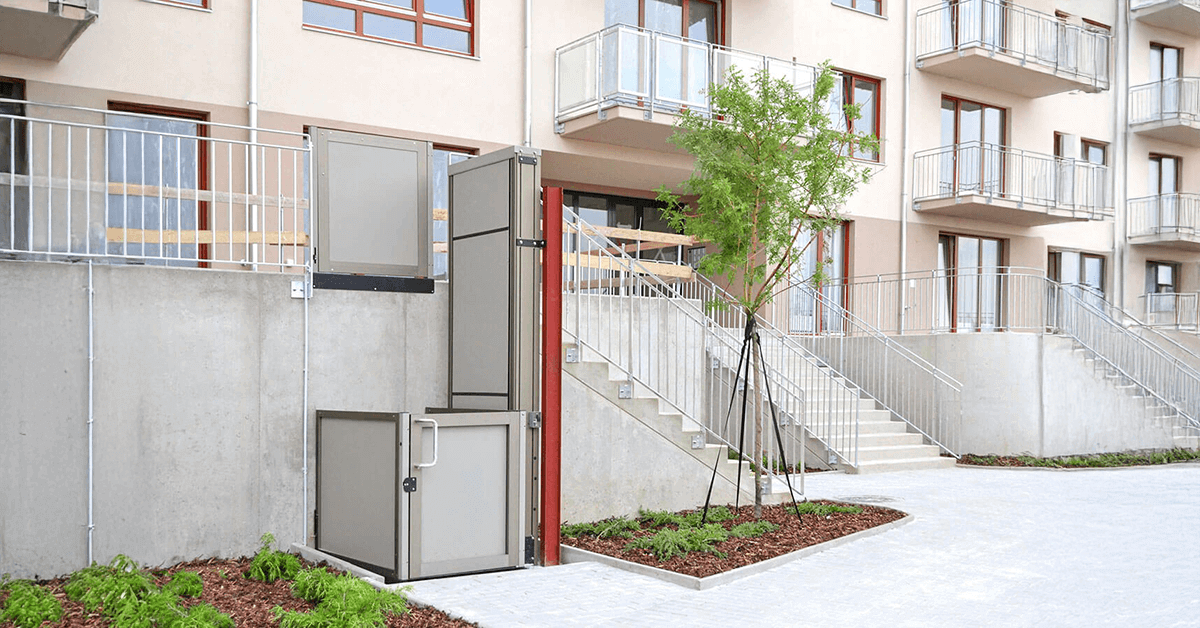
The OPAL is an unenclosed vertical platform lift designed for short vertical travel, typically up to about 63 inches (5 ft 3 in). The platform includes guard walls, a lower gate mounted to the platform, and an upper gate attached to the landing — together forming a safety barrier around the occupant during travel.
It supports a load of up to 750 lbs (340 kg), and is built for both indoor and outdoor use. (The lift can be configured with various platform sizes and entry/exit configurations, including straight-through and 90° entry.
Two drive systems are available: a 2 HP leadscrew drive or a 3 HP hydraulic drive.
In short, the OPAL is a space-efficient, relatively simple vertical access solution, ideal for short-rise conditions where a full elevator or long ramp would be overkill or impractical.
Why OPAL Is a Smart Choice for Short-Rise Accessibility
Compact Footprint Compared to Ramps
Ramps that meet accessibility guidelines often require long slopes and generous landings to meet slope ratio and clearance requirements. That can consume space and interfere with design. By contrast, the OPAL lift occupies a small footprint and provides vertical travel without requiring long ramp runs or slope-compliance calculations.
Compliance-Ready Under ADA/TAS for Short Rises
As an unenclosed vertical platform lift, the OPAL meets recognized accessibility guidelines for vertical mobility over short distances — making it a compliant option for entrances, porches, and other short-rise barriers.
Because the platform includes safety gates, mechanical interlocks, and obstruction sensors beneath it, it provides built-in safeguards that support safe and accessible use.
Speed of Installation & Lower Construction Complexity
Compared to full elevators or extensive ramp systems, installing an OPAL is often faster and requires far less structural work. It generally avoids the need for deep pits, long hoistways, or major framing changes. This can reduce upfront construction time and cost.
For clients and planners working under tight schedules or budget constraints, OPAL is an attractive, efficient solution.
Flexibility for Indoor or Outdoor, Residential or Commercial Use
Whether you’re retrofitting an older home entrance, upgrading a public building, or adding access at a small church or community facility, the OPAL’s versatile configuration works across many environments. Its platform and enclosure options make it suitable for both indoor and outdoor settings.
Planning Considerations for Contractors & Architects
If you’re specifying the OPAL for a project, keep these factors in mind:
- Vertical travel limit — OPAL is ideal for rises up to about 63 inches. For higher vertical rises, a full elevator or shafted vertical platform lift may be required.
- Landing configuration — Plan for proper landing clearance on both entry and exit sides; ensure the upper gate and platform gate align correctly.
- Access path and thresholds — Ensure smooth, level landings for easy wheelchair or scooter access to the platform.
- Power source and optional backup — OPAL offers hydraulic or leadscrew drive; hydraulic models may support battery-powered backup lowering for added safety.
- Code and regulatory review — Even with a compliant platform lift, local building, fire, and accessibility codes must be reviewed before installation.
- Use case suitability — OPAL is designed for short-rise access; for heavy traffic or higher rises, consider a more robust lift or elevator.
Real-World Scenarios Where OPAL Works Well
- Providing wheelchair or scooter access from a raised porch or stoop without building a ramp
- Making older buildings accessible where ramp construction is impossible, or space is limited
- Offering a compact entry solution for small commercial buildings, churches, or public facilities needing ADA-style access over a short rise
- Serving as an economical alternative when full elevator installation is cost-prohibitive or structurally complex
Conclusion: OPAL as a Compliance-Focused Short-Rise Solution
For short-rise barriers, the Garaventa Genesis OPAL provides a reliable, code-aware solution that balances accessibility, simplicity, and cost efficiency. For contractors and architects looking to meet ADA or TAS access requirements without the footprint of a ramp or the complexity of a full elevator, OPAL can be a smart, practical choice.
If you’re working on a project and need help specifying lift requirements or want to confirm which solution meets your design needs, contact our team at Lift-Aids. We’d be happy to provide guidance, site evaluation, and planning support.