
10 Mar Ceiling Track Lifts for Home Caregivers: How They Work and Why They Reduce Injury Risk
If you are caring for a loved one at home, you already know how physically demanding it can be. Helping someone move from bed to a wheelchair. Getting them into the bathroom. Repositioning them through the night. These are not occasional tasks. For many family caregivers, they happen multiple times a day, every single day.
And they are taking a serious toll.
The most commonly injured areas for caregivers are the back, neck, and shoulders. These injuries are often caused by overuse, from repeating the same lifting or pulling motions again and again. For family caregivers working without professional training or equipment, the risk is even higher. Unpaid family caregivers are perhaps at the highest risk of back injury since they tend to have little experience with patient handling tasks and are provided little or no training.
A ceiling track lift does not eliminate the work of caregiving. But it removes the part most likely to injure you.
What Is a Ceiling Track Lift?
A ceiling track lift is a motorized system mounted to the ceiling of your home. A track runs along the ceiling between rooms or within a single room. A motorized unit travels along that track and connects to a sling that supports the person being transferred.
The caregiver operates the system with a simple hand control. The motor does the lifting. The person being cared for is raised, moved, and lowered smoothly and safely, without the caregiver bearing the weight.
That is the key difference between a ceiling lift and manual transfer. The load moves from your back to the structure of your home.
Why Manual Lifting Is More Dangerous Than Most People Realize
Most family caregivers underestimate the physical forces involved in a transfer. The numbers from research are striking.
According to the National Institute for Occupational Safety and Health (NIOSH), the maximum safe force on the lumbar spine is 764 pounds. But the force exerted by one person lifting a patient without specialized equipment can range from 1,424 to 2,062 pounds. That means a single manual transfer can put more than twice the safe load on your lower back, every time you do it.
Repetition makes it worse. Back injuries to caregivers can develop over time, often without the caregiver’s awareness. A caregiver can sustain disc damage gradually and not feel any pain, and by the time pain appears, there can already be serious damage.
The research on what happens when mechanical lifts are introduced is equally clear. When patient handling equipment was implemented in healthcare settings, the number of injuries from patient transfers decreased by 62%, lost work days decreased by 86%, and workers’ compensation costs decreased by 84%. Those numbers come from professional care settings, but the biomechanics are the same at home.
What a Ceiling Track Lift Actually Does for You
Beyond the injury data, here is what caregivers who use ceiling track lifts consistently report:
Transfers become manageable alone. Many family caregivers cannot safely perform transfers without a second person. A ceiling lift changes that. One caregiver can safely position the sling, operate the hand control, and complete the transfer.
Dignity is preserved. For the person being transferred, a ceiling lift is smoother and more controlled than a manual transfer. There is no awkward gripping, no struggling, and no risk of being dropped.
Daily tasks become sustainable. Bathing, toileting, repositioning in bed, and moving from room to room. These tasks become repeatable without the physical cost accumulating in your body over months and years.
Caregiver burnout is reduced. Physical exhaustion is one of the leading drivers of caregiver burnout. Removing the most physically demanding part of daily care has a real effect on how long a caregiver can sustain their role.
The Ceiling Track Lift Options We Offer at Lift-Aids
At Lift-Aids, we carry the GoLift family of ceiling track systems. Here is a quick breakdown of each model:
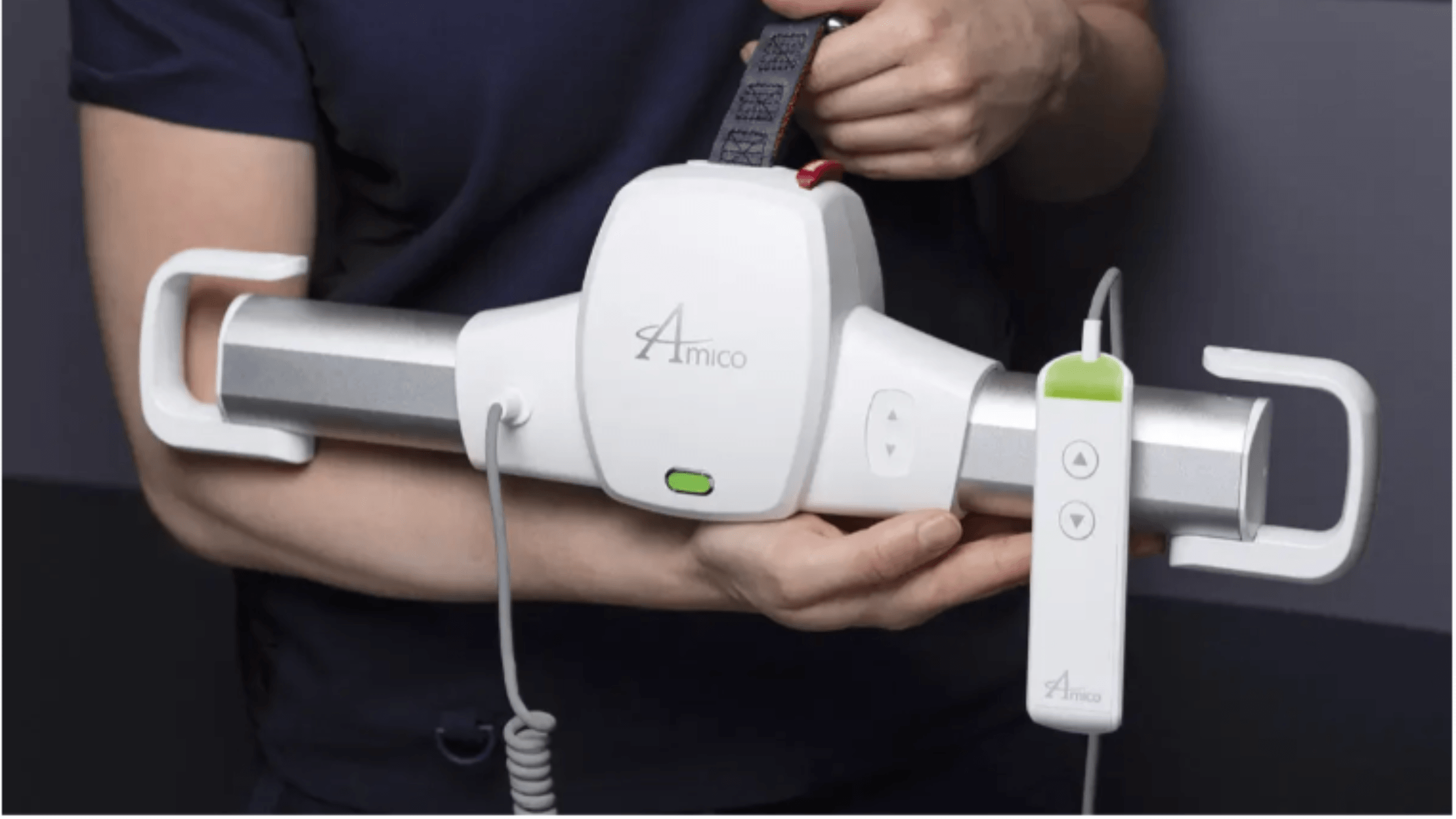
GoLift 400/700. This is the standard residential model and the most common choice for home caregivers. It features the world’s smallest patient lift motor at only 10 pounds, which reduces ceiling load and simplifies installation. Lifting capacity is 400 or 700 pounds, depending on the configuration. It operates with a single hand control with simple up and down arrows and an LED status indicator. The quick-change battery design means minimal downtime.
GoLift 1000. This is the bariatric option. It combines two GoLift 700 systems into a single trolley for a lifting capacity of 1,000 pounds. It retains all the same infection-control and ease-of-use features as the standard model.
GoLift Portable450. At only 6 pounds, this is the lightest portable ceiling lift available. It can move between rooms and integrate into multiple track systems, which makes it the right choice for caregivers who need flexibility across different spaces in the home. It provides up to 55 lifts per charge, depending on the weight of the person being transferred.
All three models are designed with smooth edges and rounded corners for easy cleaning, an important feature in home care environments where infection control matters.
You can see the full specifications on our ceiling track lifts page.
What to Think About Before Installing
A few practical considerations before you move forward:
Track layout. The track system is mounted to your ceiling joists and can be configured for a single room or extended between rooms. The layout depends on where transfers typically happen in your home, most commonly the bedroom and bathroom.
Weight capacity. Choose the model that matches the weight of the person being transferred, with some margin. Do not undersize the system.
Portable vs. fixed. If transfers happen in multiple rooms and a fixed multi-room track is not practical, the GoLift Portable450 lets the motor move between existing track sections.
Professional installation. Ceiling track lifts are mounted to the ceiling structure. Installation should always be performed by a qualified provider who can assess your ceiling, confirm the right mounting points, and verify that the system is safe before use.
For situations where a permanent ceiling system is not yet in place, our portable lifts and evacuation chairs can serve as a bridge solution or complement an existing setup.
This Is Not Just Equipment. It Is Sustainability.
Family caregivers often put their own health last. That is understandable. But a caregiver who is injured cannot provide care. A caregiver who burns out physically leaves a gap that is hard to fill.
A ceiling track lift is not a luxury. For families providing daily hands-on care at home, it is one of the most practical investments you can make in the long-term sustainability of the care itself.
Ready to Make Caregiving Safer?
Most families we work with tell us the same thing after installation: they wish they had done it sooner. Not because the equipment is life-changing in some abstract way, but because they had not realized how much the daily physical toll was adding up until it stopped.
If you are caring for someone at home in the Dallas-Fort Worth area, we want to help you find the right solution for your space. We will come to you, assess the layout, and give you a straight answer on what works and what it will cost.